Showing posts with label children's books. Show all posts

Friday, April 12, 2013

The Skinny -- Rie Cramer

Rie Cramer
Marie Cramer, better known as Rie, was an illustrator of her times.  Her images perfectly capture the essence of the 1920s and 30s, from her color choices to her linework and detail to her subject matter and point of view.  Her work features flowing Art Nouveau figures, with bright, saturated color, and lots of personality.  We Blackbird girls love illustrators, and her work makes us so, so happy.

The youngest in a family of four girls, Rie Cramer was born and raised in the Dutch East Indies, more specifically in Java, Indonesia, in 1887.  Her father, Henry Cramer, was often absent, as he was with the "packet service", traveling on ships with cargo.  Her mother, Elisabeth Frederika Schenck, took Rie and her sisters back to The Netherlands when she was 9 years old, and she attended an art academy in The Hague, the third largest city in the country, from 1905 to 1907.


At 17, she left a folder of her work -- drawings and rhymes -- with a publisher, W. de Haan, in Utrecht.  They loved it, and she got a contract in 1906 to do the book, Of Girls and Boys.  She did a sequel a year later.  

"In contrast to the then usual moralistic and educational children's books were these playful books about domestic life and the world of the child. The illustrations were not only informative, but appealed to the imagination and made the book much more accessible to children than the usual children's literature."*

Rie went on to illustrate books for other Dutch authors, like Nienke Hichtum and Anna Sutorius, as well as the classics, like Grimm's Fairy Tales and Alice in Wonderland.  She was heavily influenced by the art of other illustrators from around the world, like Arthur Rackham and Edmund Dulac.  She worked with a dark black outline, and then filled in with watercolors.

  
Rie was married two times, both ending in divorce, and she had a passionate, life-changing affair with married art critic Albert Plasschaert that ended in 1919.  She had no children.  But she lived for her art, going on to make dolls, ceramics, and even write plays and novels under a pseudonym.  She also wrote for a children's magazine, Sunshine, in the 1920s and 30s.


World War II was especially difficult for Rie.  In 1940, the Germans invaded the Netherlands.  Two of Rie's pre-war novels, She,We, and You and The Land of Promise were banned for their anti-Nazi message.  She worked against the Nazis, hiding refugees and writing poetry, called Verses of Resistance.  Through it all, though, she continued to illustrate children's books.  After the war, her fame spread to Britain and beyond, and she wrote a series of children's radio shows, of which 42 episodes aired in 1954 and 1955.

The Little Mermaid

Rie's later years were spent in Mallorca, living with friends.  According to her, it was the best time of her life. She wrote several books about Mallorca, and her love for cats.  She was crazy about her cats, and even posed with one of her cats for her passport photo.  In 1971, she moved back to the Netherlands.  Rie died at the age of 89 in 1977.  


Critics have said that Rie neglected part of society with her art, focusing too much on the whimsy and beauty, and not enough on the realness of the world during the time she worked.  However, her lighthearted, beautiful art speaks more to me because the fantasy she put into every illustration.  Rie captured the most important element of childhood in her work -- imagination and fun.

*http://www.fairyworx.net/Rie_Cramer.html

Friday, September 7, 2012

The Skinny: Is That a Wocket in Your Pocket, or What?

We both love Dr. Seuss. Who doesn't? I have a hard time imagining any part of the world that hasn't heard of The Cat in the Hat, at least. The Grinch is one of my favorite literary characters. I actually had the temerity to call myself a Seuss book collector, until I recently encountered not one, but TWO, titles that I had never even heard of. So I decided it was time to learn a little bit more about the good doctor, who was so influential in my childhood.

Yeah, so he wasn't really a doctor. Most people know that already. Theodor Geisel, the soon-to-be Dr. Seuss, went to Dartmouth, where he edited their Jack-O-Lantern humor magazine until he got booted from the editorial staff for his role in a very illegal drinking party (it was during Prohibition, after all). He did continue to submit work to the magazine, though, and he signed it "Seuss" (his middle name). Afterward, he went to Oxford, dropped out, traveled a bit, got married, and finally settled into a career as a cartoonist for Judge and The Saturday Evening Post.

Life Magazine:May 1934; from webdesignerdepot.com

One of his cartoons for Judge caught the right person's eye, and he spent seventeen years doing ad campaigns for Standard Oil (and a few other companies, including Ford, General Electric, and Schaefer). As it was the Great Depression, this steady work provided crucial financial support as he started to write and illustrate his own material.

http://libraries.ucsd.edu/speccoll/dsads/#

Schaeffer Bock Beer advertisement
http://libraries.ucsd.edu/speccoll/dsads/#intro


Although he had made a career off of cartoons for various magazines (adding LIFE and Vanity Fair to the list), his first "literary" break came when Viking Press commissioned his illustrations for a book of funny sayings called The Pocket Book of Boners in 1931. I own a later hardback copy, but here's a picture of the earlier paperback version:

www.mentalfloss.com

 In 1937, he published And to Think That I Saw It on Mulberry Street (after twenty-seven rejections). A first edition with dust jacket now ranges from $8,000 to $12,000, depending on condition. He followed this success with The 500 Hats of Bartholomew Cubbins in 1938 ($6,000-$9,000), and The Seven Lady Godivas in 1939 (they're naked!).

mirrormaskcamera.tumblr.com


Although he was too old to be drafted, he made his own WWII contribution by writing military training movies for Frank Capra's Signal Corps, featuring Private Snafu as a recurring character. You might notice some similarities between the Snafu films and some certain other very famous cartoons, and the reason is simple: they were a secret project done by Warner Brothers for the War Department. (Actually, the job was first offered to Disney, who wanted too much money.) This put Seuss together with some of the great Warner Directors, including Chuck Jones and Friz Freleng. And who provided the oh-so-familiar voice for Private Snafu and his fellow soldiers? Mel Blanc. I can't even get into how excited that makes me--Mel Blanc, Chuck Jones, and Dr. Seuss in the same room. Here's Private Snafu in the Aleutians (but there's also a great one called Booby Traps that runs about 5 minutes--check it out on YouTube if you get a chance):


His two most famous works, The Cat in the Hat and How the Grinch Stole Christmas both came out in 1957.  But there are some lesser-known works that are just as fabulous: Thidwick, the Big-Hearted Moose (1948), On Beyond Zebra (1955), and Did I Ever Tell You How Lucky You Are? (1973) . Overall, more than sixty titles bear his name. I was shocked to learn that he had another pseudonym (Theo LeSieg), under which he published books that he wrote, but did not illustrate. Some of these were on my favorites list as a child, and I didn't even know they were his! The Tooth Book changed my life, people.

 Dr. Seuss has always been in my world. My preschool class had a Green Eggs and Ham party, and I was so excited I nearly peed. I always loved the fact that my mother could recite Fox in Socks rhymes, fast, without getting tongue tied. Horton heard that Who at least once a week during a particular summer of my childhood.

And now we brag on the great Dr. Seuss:
Academy Awards........2
Pulitzer Prizes.............1
Emmy Awards............2
Peabody Awards.........1
Books sold..................200,000,000+
People who are more creative, smarter, wittier, kinder, and/or funnier because they read his books.......probably billions.

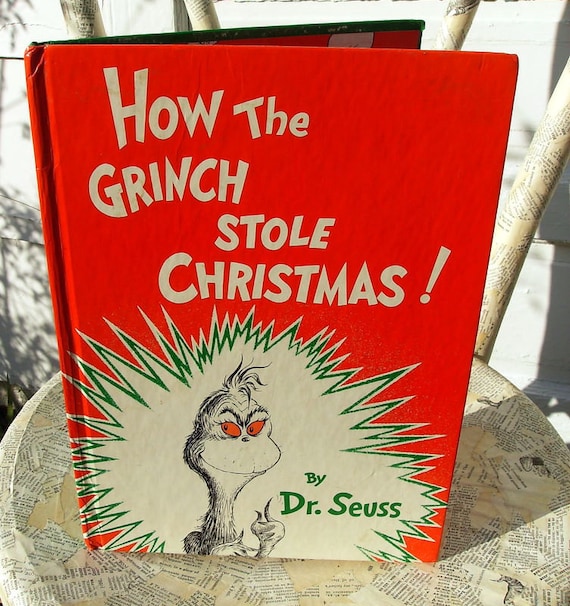
How the Grinch Stole Christmas, Dr.Seuss, 1985 copy
In our etsy shop: https://www.etsy.com/listing/87913830/how-the-grinch-stole-christmas-drseuss?ga_search_query=grinch

* Information obtained from http://www.catinthehat.org/history.htm, http://1stedition.net/drseuss.html, www.wikipedia.com