Showing posts with label art. Show all posts

Wednesday, January 15, 2014

On the Radar -- Color Cues, Part Deux

It's been a year since my last Color Cues post -- using fresh art from Etsy as inspiration for color palettes to spruce up your home or your design project.  I pay attention to trends, in the sense that I usually like something before it's trendy and then I promptly forget that it's trendy when it hits. 

Really, trends are interesting, in an abstract kind of way.  I mean, I do write a trend post on this blog.  But sometimes, I just like to find what appeals to me, what pulls at me, and then go from there.  That's what I've done here.  Enjoy -- and hey, buy some art from these great artists!

Fernet Branca screen print by KRUSTYstuff on Etsy, here.
 
Bella Fiore nr.4, Aqua and Coral Red art print by IsaBella by Margriet on Etsy, here. 
 
Fruit fine art photograph by LupinGrainne on Etsy, here.
 
Large Abstract Painting by Lola Donoghue on Etsy, here.


Saturday, May 25, 2013

The Skinny -- Ophelia

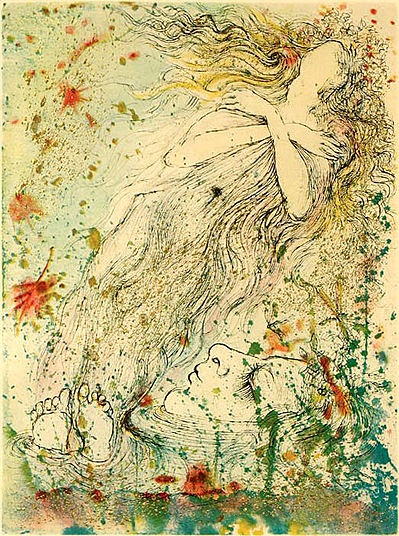
Salvador Dali, Ophelia's Death
I started this blog post with the goal of showing the impact of interpretation of a character over time through art -- i.e. how a character becomes ingrained into our culture and is transmitted through certain visual cues.  I wanted to focus on Ophelia, starting with paintings and drawings and moving into modern photography. 

However, we Blackbirds took a break.  And went to a new coffee shop in town for a macchiato (me), black cherry soda (her), and a shared lemon sugar cookie (yum).  What can I say -- it's our way.

While sharing that cookie, though, we started talking about something completely different.  About another character, even more well known than and not even remotely connected to Ophelia, and how that character has become known for certain traits and ideas that originate from sources other than what we believe to be the original text.  This character is revealed more in the way he is perceived by others, than by his actual appearance in the text.  His personality is gathered from multiple cultures and stories.  And the traits that make him most famous are mostly left up to interpretation.

It was kind of a shocking realization.

John Everett Millais

Paul Albert Steck, Ophelia Drowning
And when we got home, I made a connection between the two ideas, and realized that Ophelia's character is sort of the same way.  We learn more about her through the way she is perceived by the other characters in Hamlet than we do through her own lines.  I found a website that listed Ophelia's lines in the play -- they were pretty boring and honestly, there weren't very many of them.  Mostly obedient little single lines until she cracks up.  But man, did the other characters talk about her!
 
Culturally, however, she has become a female icon (for good or for bad, take your pick); she has become "OPHELIA," not just Ophelia.  She represents love lost and melancholy.  Depression.  A lover to scorn, a betrayed daughter, a sister to avenge.  A madwoman.  Ultimately, a woman who can't make her own choices about her life; she is bound to be obedient to her father or her husband, given the restrictions of the society of her time.  She is the representation of goodness, in contrast with Hamlet's faithless mother, Gertrude.  But, eh, Hamlet still verbally abuses Ophelia, and she dies (or kills herself -- it's debatable).


Dante Gabriel Rossetti

Old Shakespeare lets Hamlet's mom break the news:

When down her weedy trophies and herself
Fell in the weeping brook. Her clothes spread wide;
And, mermaid-like, awhile they bore her up:
Which time she chanted snatches of old tunes;
As one incapable of her own distress,
Or like a creature native and indued
Unto that element: but long it could not be
Till that her garments, heavy with their drink,
Pull'd the poor wretch from her melodious lay
To muddy death
.

The description of her death, from Gertrude's lips, sounds not too bad actually.  She looked good -- mermaid-like -- and she didn't really even realize, "Hey, I'm drowning!''  She was too busy singing.  Darn those heavy, wet clothes!

John William Waterhouse

So, over the years, artists have gleaned some important (to them, at least) ideas from her story -- Ophelia was pretty, she had some flowers, and she had some nice clothes.  Oh, and she was kind of sad.  And they ran with it, making her into the poster child for "Woe is me!" and "He don't love me no more!" Oh, and "Goodbye cruel world!"

Paul Delaroche
Arthur Hughes
Henry Lejeune

Personally, I prefer Natalie Merchant's version of her character, highlighted in her album, aptly titled Ophelia.  The entire album is a statement for women's rights, arguing against limiting images of women as "mother" or "whore", and calling out Ophelia as a woman who had to fight against patriarchal, male dominated society.  It also helps that the songs are really good -- beautiful and simple and strong.

Ophelia's mind went wandering
You'd wonder where she'd gone
Through secret doors
Down corridors
She'd wander them alone
All alone... 
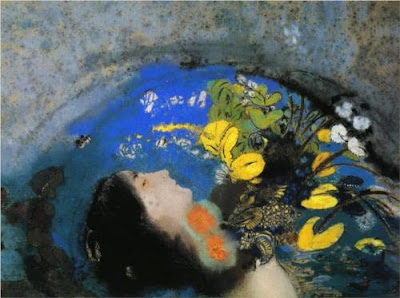

Odilon Redon

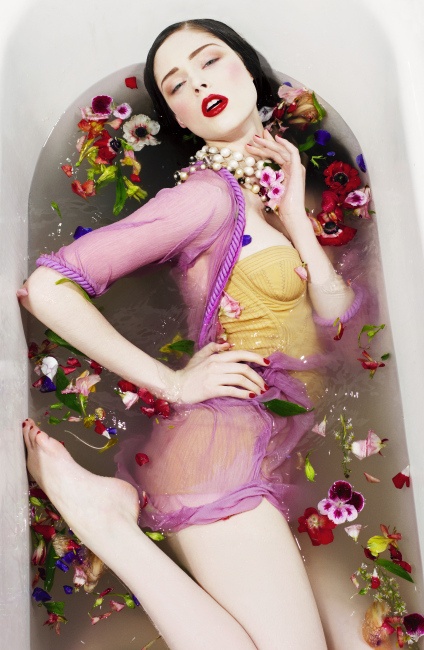
But what would today's Ophelia look like?  Fashion has the answer.  She can be soft and dreamy, like this:

Rooney Mara for Vogue
Or bold and feminine, like this:

Coco Rocha
Either way, she's an icon -- a mystical female archetype full of romance and tragedy.  So screw you, Hamlet.  Ophelia's way cooler.

Michael James Talbot


Friday, May 10, 2013

The Skinny -- Genia Rubin

To use a stupid little phrase we Blackbird girls use quite frequently -- if wishes were dreams...then I would have more wall space in our house.  Well, I'd just have more house to our house.  Extra rooms, extra display space, extra wall space for more art.  And if wishes were dreams, I could have vintage (OK, I could only afford prints...) fashion photography and portraiture.  You know, the really good stuff, like Richard Avedon and Cecil Beaton.  And this guy, Genia Rubin.

I recently stumbled upon the work of Genia Rubin, and although I haven't been able to find much out about his life, I thought I could at least share some of his stunning work with you, our readers.  His work has a surrealist vein running through it, showing "provocative forms of unrestrained, convulsive beauty."* 

Genia Rubin (real name: Yevgeny Hermanovitch Rubin) was born in Kiev in 1906, and died in Paris in 2001.  He left Russia in 1927, traveling to Berlin, where he assisted Karl Freund, cinematographer for Metropolis (1927) and an Academy Award winner for Best Cinematography in 1937 for The Good Earth.  


Rubin went to Paris in 1929, where he worked as a still and portrait photographer in the Pathé Film Studios, a company which produced over 70 feature films between 1929-1935, including some of France's first talkie pictures. In 1931, Rubin returned to Berlin, where he met the well-known portrait photographer, Rolf Mahrenholz.   He opened his own photo studio in the Kurfürstendamm, one of the most famous avenues in Berlin.   


Rubin soon began working with fashion magazine editor, Franz Wolfgang Koebner, the editor of a popular magazine, The Elegant World.  It launched his fashion career.  In 1935, he moved back to Paris, where he met photographer Harry Ossip Meerson. They collaborated, and after Meerson's departure for America, Rubin took over his studio.


During his fashion career, Rubin photographed for Indian magazine Femina, Harper's Bazaar and Australian magazine, The Home. After WWII, he met the English court photographer, Baron Stirling Henry Nahum, and until 1956, Rubin worked alternately as a guest fashion photographer in Baron's London studio and as a photo correspondent for the Daily Express in Paris.

 
Through his acquaintance with André Breton, the founder of Surrealism, Rubin learned about contemporary painting in Paris in 1947, and his work was represented that year, along with other artists', in the international Surrealist exhibition at the Galerie Maeght, a gallery for modern art, founded in Cannes in 1936.

 
In 1957, Rubin worked for Maison et Jardin (House and Garden, Condé Nast ), photographing parks, gardens, palaces and works of art in France, England and Italy. From 1959 on, he devoted himself again to his modern painting and photography.

  
 And that's it folks.  That's all I've got!  The Biksady Gallery in Budapest had an exhibit of his work in February through March of this year, and that's where I got most of the images.  I'm definitely intrigued now, and I'm going to dig some more.  Hopefully you enjoyed the images -- and I'll leave you with one of his lovely portraits!


* From the Metropolitan Museum of Art, here.

Wednesday, February 27, 2013

On the Radar -- Bacterial Beauty

Fractal art by Sylvia C., here.
It's ridiculous how in tune we Blackbird girls are with each other.  Sometimes it gets a little spooky.  I got the image to the left in an email newsletter from Patternbank.  It's digital, fractal art by Sylvia C. that looks like magnified bacteria/fungi/icky junk. I thought Ms. Blackbird, the Biology edition (i.e. not me, the other one), would dig it.  So I emailed it to her.  She then sent me this beautiful image of real bacteria under stress:


Turns out she'd been looking at images of real magnified biology thingies already.  Needless to say, it's escalated since then, and we've been looking at magnified bacteria (among other things) a lot lately.  Turns out, we're not the only ones inspired by bacteria.  Surprise, surprise!

I've found lots of artists that have been recently inspired by magnified bacteria.  Here's a quick selection:

Bacteria art using pasta and bamboo skewers, Sinead Foley
Glass E.Coli, by Luke Jerram. At the Museum of Art and Design NYC through April 7
Balloon bacteria, Jason Hackenwerth
Bacteria watercolor, Sarah Roberts
Clothing and accessories using real bacteria, Sarine Zakin
Designer Iris van Herpen, 2013
SAYMYNAME, 2013, Pathovar (bacterial strain) collection

Wednesday, February 6, 2013

On the Radar -- The New Filigree

For today's On the Radar, we thought we'd talk about about what we call "new filigree."  We call it filigree for the openness and lace-like quality of the work, and we love that the design is created from what are, essentially, scribbles.  I mean, these people know how to scribble -- I couldn't do it at all -- and that's what makes it true art.  They possess the natural ability to just know what works, and the skill to create such beauty.

By Angelika Arendt, from here.

I love the intricacy and delicacy of these designs, but don't think they are fragile.  These patterns are bold, and in your face, modern and fresh.  They can be totally abstract or, like the one above, can include realistic elements.

from emilylynchart on Etsy, here.
There's more to it than just art for your wall, though.  The new filigree translates into many different mediums:
 

Scribble Sketchbook by Maroon Lagoon on Etsy, here.


Sterling necklace by Helen Bunch, here.
Bracelet and ring set by Rich Made on Etsy, here.

And, everything old is new again...this vintage dress from our Etsy shop!

1960s dress from our shop on Etsy, here.

Wednesday, January 16, 2013

On the Radar -- Color Cues

Ok, so if you follow this blog, you know that we Blackbird girls love art.  The walls in our house are covered, and we really don't have room for any more pieces.  We can only buy really, really small pieces now -- so that we can fit them in between the larger pieces.

So, to appease the desire we have to acquire new art, we thought we would give to you, our readers, a taste of what we like.  What we think is cool.  And you know, what we think is on trend for right now.  And through this, we will get the feeling that we have gotten new art for our walls.

You get a bonus, too, though!  We've done some color schemes to coordinate with the art, so that you can buy that painting, and then redecorate around it!  Choosing colors can be difficult, and we have the philosophy that the more color, the more fun.  A great guide to know which colors "go" together is art.  Successful painters, photographers, and designers have a natural ability with color.  When you find art you love, then use it.  Steal their color scheme!  Let them do the work for you!

For your enjoyment, our favorite new art from Etsy:

Feather Watercolor Painting by River Luna on Etsy


Photograph by lightplusink on Etsy


Encaustic Painting by tincaustics on Etsy

*All paint samples are either Glidden or Behr from The Home Depot.

Friday, January 4, 2013

The Skinny -- Fornasetti

Piero Fornasetti
You probably know his work even if you don't know his name.  Piero Fornasetti's art is instantly recognizable and graphically stunning.  He was not only a painter, but also a sculptor, interior decorator, designer, printmaker, and engraver. He created more than 11,000 products from his art, ranging from furniture to ceramics to wallpaper. 

Born in Milan in 1913, Fornasetti attended, and was expelled from, Brera Academy, where he studied drawing, in the first two years of the 1930s.  A year later, in 1933, he exhibited his very first piece of art in a student exhibition at the Milano University.  Fornasetti also designed a group of silk scarves, printed with newsprint and architectural motifs, exhibited at the Milan Triennale. 

He was conscripted into the Army during WWII, but instead of fighting, he was given the task of painting the regimental barracks in the Piazza San Ambrogio.  He was exiled to Switzerland from 1943 to 1946 to avoid more military service, but continued to produce his art throughout this time.

In 1940, Fornasetti met Gio Ponti, an Italian architect and designer, and designed ‘The Lunar’ illustrated Calendar book for him.  He worked continuously with Ponti until his death in 1979.  They collaborated on designing art, products and furniture, as well as interiors, such as the complete interior of the Casa Lucano, the ocean liner Andrea Doria, and the ballroom of New York's Time-Life building.


Fornasetti's most important contribution was the joining of design and art through furniture, interiors, and products.  He was one of the first to develop the idea of "branding" himself and serially producing his art for public product consumption.   

His work includes constant use of black and white, the sun and time. His style is heavily influenced by Greek and Roman architecture.  His most famous work is, without a doubt, his illustrations featuring the face Lina Cavalieri, an operatic soprano.  Fornasetti found her face in a 19th century magazine, turning the black and white image into an iconic representation of his work. It was known as the “Tema e Variazioni” (theme and variation) plate series.  He said:
“What inspired me to create more than 500 variations on the face of a woman? I don’t know. I began to make them and I never stopped.”  

Tema e Variazioni

Fornasetti's work faded in popularity throughout the 1970s, but with the opening of the design store, Themes and Variations, in London in 1980, interest was reawakened. He published a book in 1987, a collaboration with Patrick Mauriès that illustrated his collective works.  Piero Fornasetti died in 1988 at age 75.  His son, Barnaba Fornasetti is continuing his dad's legacy by continuing to produce his work.


Covered Latte Cups from Barking Sands Vintage on Etsy
*Information from http://www.fornasetti.com, wikipedia, and www.sinaiandsons.com